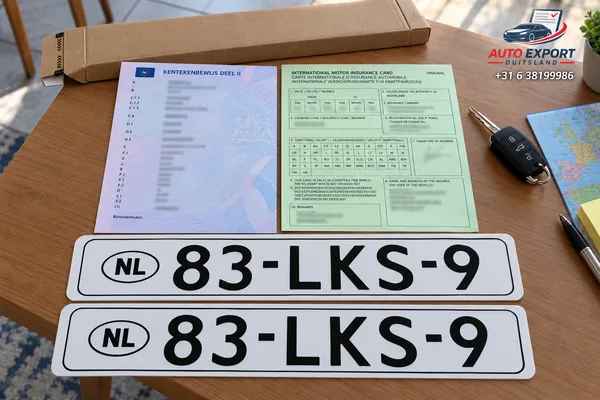
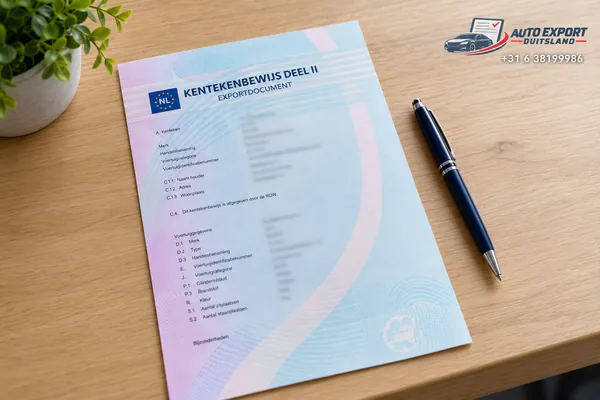
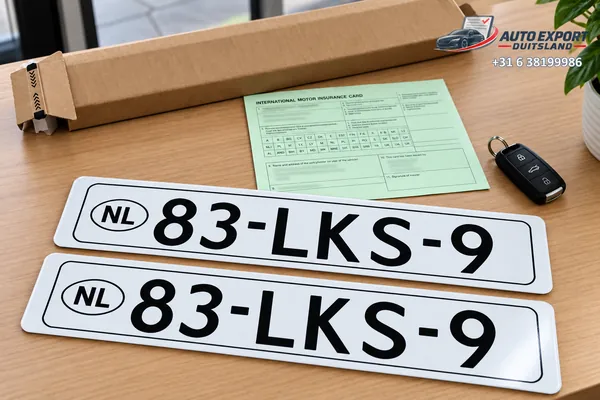
Export document
from €50
- Export certificate (registration certificate part II) for the buyer
- Indemnification certificate (vrijwaringsbewijs) for the seller
- Deregistration and processing with the RDW

We handle the Dutch side of importing a car to Germany: the export document, white plates and 14 days of export insurance. The complete package starts from €150, and the German steps are explained below.
from €50
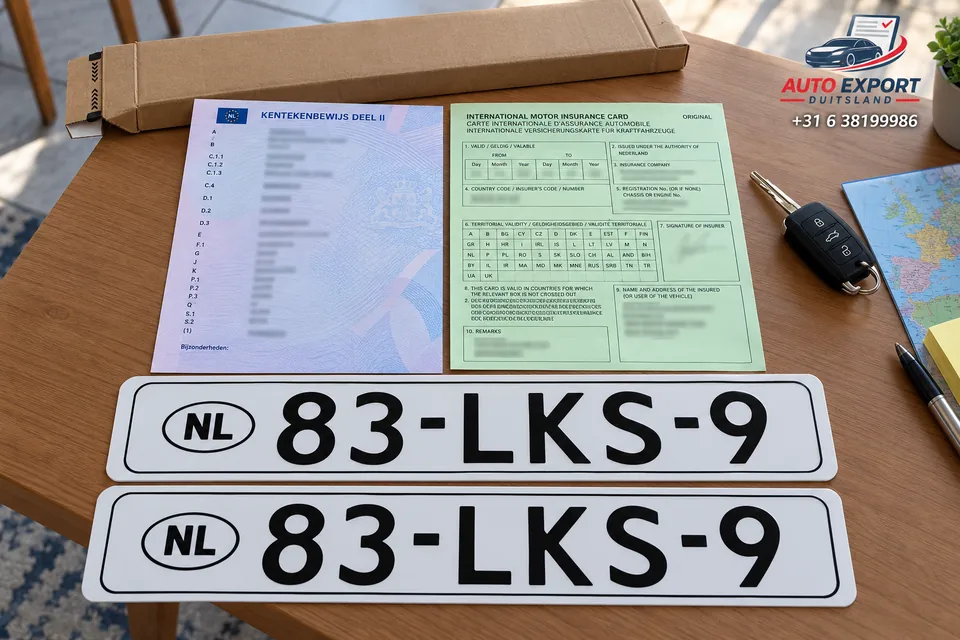
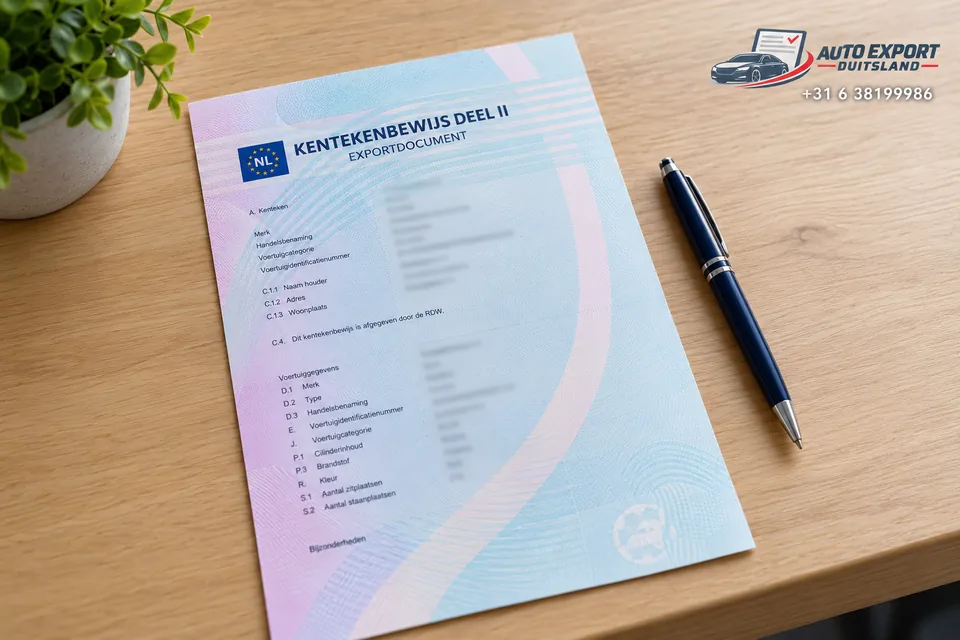
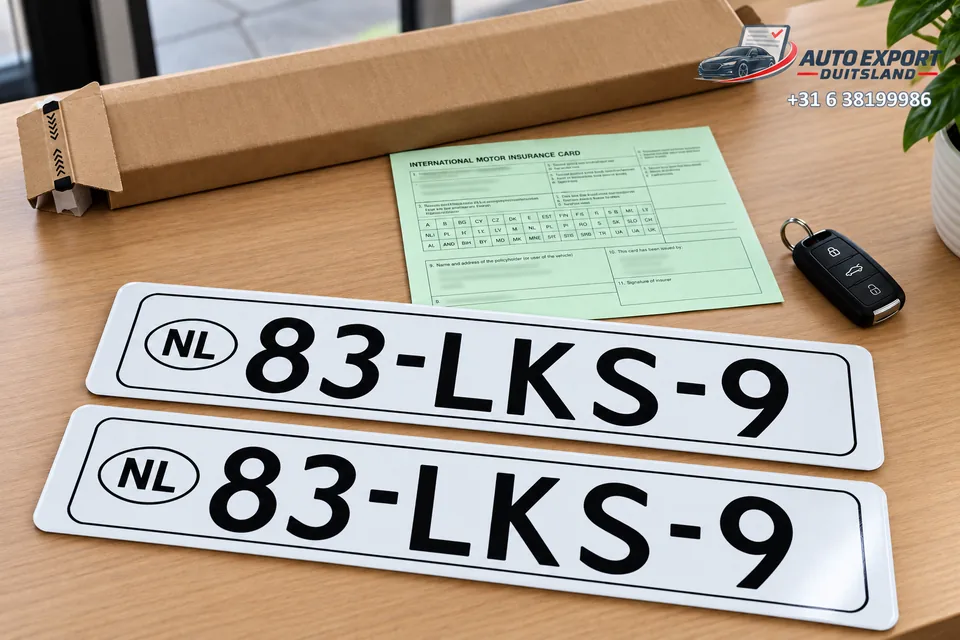
Have you bought a car, motorhome or van in the Netherlands, or are you taking your own Dutch car with you to Germany? Then two countries are involved. The Netherlands has to take the vehicle off its register, and the German authorities have to register it. Auto Export Duitsland handles the Dutch part at its RDW-recognised export desk in Hengelo. The German registration, the Zulassung, is arranged by the new owner there, and this page explains what that involves.
We have been arranging RDW export documents, export insurance and white export number plates since 2015. Our desk is about 1 km from the A1, roughly 29 km from Gronau and about 35 km from Bad Bentheim via the A1, which becomes the German A30 at De Lutte. We have no desk in Germany, but a lot can be done remotely.
Importing a car to Germany from the Netherlands starts with the Dutch export. At our desk the vehicle is deregistered for export in the Dutch vehicle register. You then receive:
According to the RDW, the export certificate and the registration card are needed together to register the car abroad. Do not deregister the car before you know which papers you need: our page on Dutch car export documents lists them.
For the drive itself we supply white export number plates and arrange 14 days of third-party export insurance with a Green Card through our insurance partner. If the German steps take longer, the cover can be extended after approval by the insurer. Read more about export insurance for the drive to Germany and the white Dutch export plates. We also offer a BPM refund service, and CoC assistance on request. An EX-A customs declaration is not needed, because both countries are in the EU.
from €50
from €100
from €150
The German registration is not something we do. The buyer or new owner arranges it, or someone acting with a power of attorney. The Zulassungsstelle (German vehicle registration office) of the place of residence asks for, among other things:
With these papers you go to an appointment at the Zulassungsstelle. The car receives a registration number and the Zulassungsbescheinigung Teil I and Teil II (the German registration certificates), and you have German number plates made, which the office stamps. Berlin and Munich publish lists like this one, and each Zulassungsstelle may ask for more. Our guide on how to register a car in Germany covers every step in detail.
Our prices start from €50 for the export document, from €100 for export insurance with white plates and from €150 for the complete package. The price is always confirmed in advance; it can be higher outside office hours, for delivery by post or for heavy vehicles. You pay in cash or by bank transfer.
On the German side, the federal basic fee for a Zulassung is €30 (GebOSt no. 221.1). The total at the counter varies by Zulassungsstelle and can be higher. After registration the Kfz-Steuer follows every year, and a private buyer only owes German VAT on a new vehicle. The page on the cost of registering a car in Germany sets out all the costs.
With complete documents, a standard application at our desk is usually ready in about 15 minutes. After deregistration the car may be driven on Dutch roads for 14 days, and never longer than its APK (the Dutch roadworthiness test) is valid. There are no transit countries, as the two countries share a border.
There is no official average processing time on the German side. With complete papers the registration itself is usually one appointment, but waiting times for an appointment vary by city. As an indication, allow a few days to a few weeks. A missing CoC (a Gutachten is then needed) or a missing deel II can make it take longer. If you want a BPM refund, the car must have its German registration within 13 weeks of the RDW giving it export status.
You do not always have to come to Hengelo. We can prepare everything online; you send the yellow Dutch number plates by post or courier, and we start once they arrive. Documents and plates are sent insured and with tracking, to a Dutch or a German address.
Is the car already in Germany, for example because you moved there on Dutch plates? Then we can still arrange the export with the kentekenbewijs deel II, entirely remotely through a separate procedure by post. Everything is sent insured with DHL: standard takes about 5 working days, DHL Express about 1 working day. Contact us first, and we will tell you what we need and what it costs. We cannot promise that the car may then be driven in Germany on white export plates.
Most of our customers fall into one of these groups. We do not sell cars ourselves.
For car export to Germany: at our desk or remotely
Route: The desk is about 1 km from the A1 motorway.
Remotely: Not nearby? We prepare the export online. You send your yellow Dutch plates by post or courier, and we start once they arrive. We send documents and plates insured and with tracking, also to Germany.
Please call or message us about 20 minutes before you arrive.
RDW-approved export company, not part of the RDW.
Call or message us for free advice or an appointment, also outside office hours. On Sundays a higher rate applies; you always know the price in advance.
No. We handle the Dutch side: the export document, white export plates and temporary export insurance. The new owner, or someone with a power of attorney, applies for the Zulassung at the Zulassungsstelle of the place of residence. We explain those steps and make sure the Dutch papers are complete.
No. Germany is a member of the EU, so no export declaration to customs is needed. You need the Dutch export document, plus export insurance and white plates if the car is driven there.
The Zulassungsstelle asks for the original foreign registration papers. According to the RDW, the export certificate (kentekenbewijs deel II) and the registration card are needed together for registration abroad, and you hand them to the authority there. The Zulassungsstelle keeps the Dutch papers.
According to the ADAC, that is the usual route for the drive to Germany, with export insurance and a Green Card. On Dutch roads the export plates are valid for 14 days and never longer than the APK. Rules for Dutch export plates vary by country, so ask the Zulassungsstelle before you drive on after the first 14 days, or choose transport.
Our complete package starts from €150. In Germany the federal basic fee for the Zulassung is €30; the total varies by Zulassungsstelle and can be higher. You also pay for the HU if one is needed, German plates and insurance, and then the annual Kfz-Steuer.
Yes. We can prepare everything online and send the documents and plates by post, also to Germany. If the car is already in Germany, we can still arrange the export by post: DHL standard takes about 5 working days, DHL Express about 1 working day. Please contact us first.
Checked on 1 November 2026
Car export prices
Starting prices, including VAT where applicable. Outside office hours, depending on the vehicle or for postal delivery the price can be higher; we always confirm it in advance. See all prices
Monday to Saturday: 10:00 to 16:30
Also open on Sundays, by appointment and at a higher rate: call or WhatsApp first for the final price.