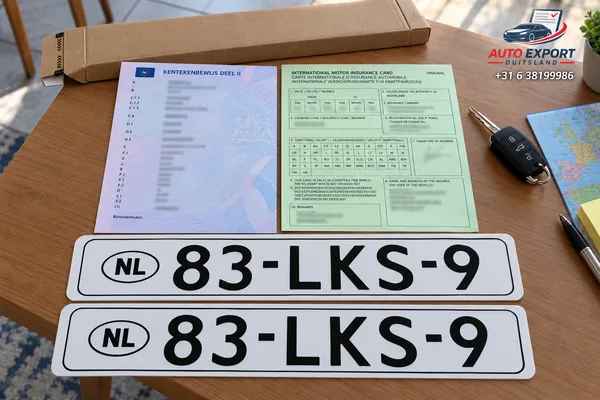
Export document
from €50
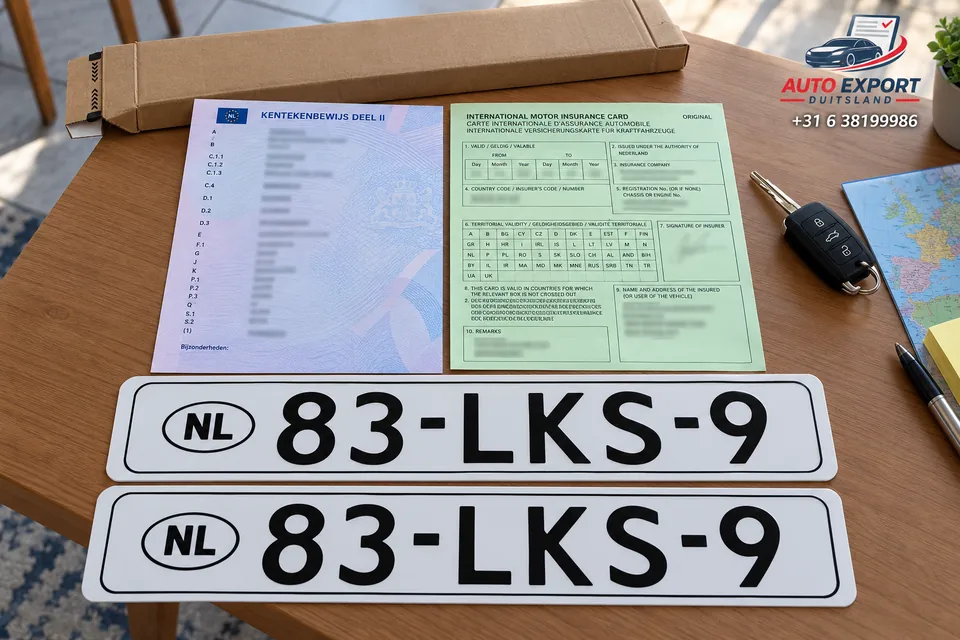
- Export certificate (registration certificate part II) for the buyer
- Indemnification certificate (vrijwaringsbewijs) for the seller
- Deregistration and processing with the RDW

When you move to Germany, your car gets a regular base there and must be registered straight away. Here is the order of steps, what happens on the Dutch side and how cross-border commuters are treated.
from €150
Moving to Germany means a new address, often a new job and a stack of forms. The car is easy to forget, yet it has rules of its own. Once you move with it, the car gets a regelmäßiger Standort (a regular base) in the country, and from then on it needs a German registration. This page explains the order of steps, the Kfz-Steuer (German vehicle tax), the position of cross-border commuters and what we arrange in the Netherlands.
The Zoll (German customs, which also collects the vehicle tax) puts it clearly: if you move from abroad and take your vehicle with you, the vehicle gets a regular base in the country, meaning it is used permanently from a location there. With that comes the obligation to register it under the Fahrzeug-Zulassungsverordnung (FZV).
No source sets a fixed number of days for this, so arrange it straight after the move. The period of up to one year in § 46 FZV applies only to a temporary stay without a regular base, such as a holiday, not to people who settle in the country. The Hauptzollamt Gießen adds that the cars of owners who have set up their fixed residence in Germany, not merely temporarily, are in most cases liable to German tax and must go through the registration procedure.
During a temporary stay, a foreign passenger car (with its trailer) is exempt from the Kfz-Steuer for up to a year. That exemption ends once the car has a regular base in Germany and, according to the Zoll, even before the year is over if you move your habitual residence to the country. Using the car without the required registration counts as widerrechtliche Benutzung (unlawful use), and the user then owes the Kfz-Steuer.
In November 2023 the Hauptzollamt Gießen reported joint checks by customs and police on foreign-registered cars, during which they look at whether back tax is due. The practical conclusion is simple: register the car straight after you move, and prepare the papers before the removal van arrives.
The registration offices ask for an identity document with a Meldebescheinigung (proof of your registered address), so a logical order is:
The basic fee for a Zulassung is €30 (GebOSt no. 221.1); the total varies by Zulassungsstelle and can be higher. Each step is explained in our guide on how to register a car in Germany.
Do you live in the Netherlands and work across the border? As long as you live in the Netherlands, the car has no regular base in Germany and normally keeps its Dutch registration. The Zoll grants a permanent exemption from the Kfz-Steuer for a private car registered in your country of residence that is used only for regular journeys between your home and your workplace there. Export and a German registration only come into play when you move.
Do you live in Germany and work in the Netherlands? Then, according to Your Europe, the EU information portal, a cross-border worker with their own car only has to register it and pay the tax in the country of residence, which in this case is Germany. Your Europe describes your normal residence as the place where you usually live, work or have a family, with more than 185 days per calendar year as a guide. That is a general EU explanation, not a German deadline.
After the export, the Dutch insurance obligation, the obligation to have an APK (the Dutch roadworthiness test) and the motor vehicle tax end for you as the Dutch owner. Your Dutch car insurance is no longer valid once the car has left the Dutch register, so you need temporary cover until the German registration. We arrange 14 days of export insurance with a Green Card through our insurance partner, and the cover can be extended, after approval by the insurer, if the German steps take longer.
BPM, the Dutch registration tax, can sometimes be partly reclaimed when you move to an EU country. The car must be registered in the new country within 13 weeks of the RDW giving it export status. We have not found a German exemption that you would lose by claiming the refund; the Belastingdienst (Dutch tax authority) decides on each application. See the BPM refund on export.
We have also not found a German registration tax for which you would need a removal exemption. The Zoll relief for household removals (Umzugsgut) applies only to moves from outside the EU, so it plays no part here. If you take a new vehicle with you, ask the Finanzamt (tax office) about VAT in advance.
from €50
from €100
from €150
Did you move first, and is the car already parked at your new home? Then we can still arrange the Dutch export with the kentekenbewijs deel II, entirely remotely through a separate procedure by post. Shipping is insured with DHL: standard takes about 5 working days, DHL Express about 1 working day. Contact us first, and we will tell you what we need and what it costs.
We cannot promise that the car may be driven in Germany on white export plates afterwards. Ask your Zulassungsstelle in advance, or have the car transported. Taking a motorhome, caravan or trailer along as well? See moving a motorhome, caravan or trailer, or contact our export desk with your questions.
Call or message us for free advice or an appointment, also outside office hours. On Sundays a higher rate applies; you always know the price in advance.
No source sets a number of days. With the move the car gets a regular base (regelmäßiger Standort) in Germany, and from then on it must be registered there, so arrange it straight after the move. The one-year period in § 46 FZV only applies to temporary stays without a regular base.
In practice, yes. The Zulassungsstelle asks for an identity document with a Meldebescheinigung, and the office of your main residence is the competent one. So register at your new address first, then apply for the car's registration.
Possibly. A refund is only possible when you move to an EU country, and Germany is one. The car must be registered there within 13 weeks of the RDW giving it export status, and further conditions apply. The Belastingdienst decides; our BPM refund service checks the conditions and handles the application.
As long as you live in the Netherlands, the car has no regular base in Germany and normally keeps its Dutch registration. The Zoll exempts a private car registered in your home country from the Kfz-Steuer if it is used only for regular journeys between home and work in Germany.
No. Once the car has left the Dutch register, your Dutch car insurance no longer applies. Our temporary export insurance gives 14 days of third-party cover with a Green Card and can be extended until the German registration, after approval by the insurer.
Yes. We can arrange the export with the kentekenbewijs deel II remotely, through a procedure by post. DHL standard takes about 5 working days, DHL Express about 1 working day. Contact us first to hear what we need and what it costs.
Checked on 1 November 2026
Car export prices
Starting prices, including VAT where applicable. Outside office hours, depending on the vehicle or for postal delivery the price can be higher; we always confirm it in advance. See all prices
Monday to Saturday: 10:00 to 16:30
Also open on Sundays, by appointment and at a higher rate: call or WhatsApp first for the final price.