Taking a van, lorry or truck from the Netherlands to Germany
For businesses and private buyers who take a van, truck or other commercial vehicle from the Netherlands to Germany. We arrange the Dutch export; prices for vehicles over 2,500 kg are on request.
- Export papers for vans and trucks
- White plates and 14-day insurance
- Quote on request above 2,500 kg
Did you buy a van in the Netherlands, or does a German customer want your truck? The Dutch export works the same way as for a car. On the German side, however, a great deal depends on the weight: tax, inspections, toll, speed limits and the driving licence. This page sets out those rules for vans, lorries and other commercial vehicles.
Van and truck categories N1, N2 and N3 against German weight limits
EU law sorts goods vehicles into categories: N1 up to 3.5 t, N2 over 3.5 t up to 12 t and N3 over 12 t. The German rules below work with weight limits of 3.5 t, 7.5 t and 12 t rather than with these letters, so check the permitted maximum mass in the papers of your vehicle before you plan anything.
Registering a commercial vehicle in Germany as a business
A van or truck goes through the same registration steps as a car: see how to register a car in Germany. The federal basic fee is €30 (GebOSt no. 221.1); the total varies by Zulassungsstelle (German vehicle registration office) and can be higher.
For a company, the Zulassungsbehörde of its seat or of the branch concerned is responsible. Berlin, for example, asks companies for a Gewerbeanmeldung (trade registration) or an extract from the Handelsregister (commercial register), as an original or certified copy, plus the identity document of the person authorised to represent the company. The other papers are the usual ones: a CoC or Datenbestätigung, an eVB from a German insurer, a SEPA mandate for the vehicle tax, proof of inspection and the Dutch export papers.
Kfz-Steuer, HU and safety checks for vans and lorries
For vehicles other than passenger cars and motorhomes, the Kfz-Steuer (annual vehicle tax) is based on the permitted maximum mass: up to 3,500 kg per 200 kg, and above that also by emission or noise class, with maximum amounts. Whether a particular van is taxed as a passenger car or as another motor vehicle (anderes Kraftfahrzeug) is for the authorities to decide, not for us.
| Permitted maximum mass | HU (roadworthiness test) |
|---|---|
| up to 3.5 t | every 24 months |
| over 3.5 t up to 7.5 t | every 12 months |
| over 7.5 t up to 12 t | every 12 months |
| over 12 t | every 12 months |
Heavier vehicles also need a Sicherheitsprüfung (safety check). Over 7.5 t up to 12 t it is due every 6 months after the first 36 months. Over 12 t it is due every 6 months after the first 24 months.
Truck toll on the drive to a German buyer
Since 1 July 2024, vehicles with a technically permitted maximum mass of more than 3.5 t that are intended or used for goods transport pay the Lkw-Maut (truck toll), according to the BALM. It applies on the Autobahn and on all of the roughly 40,000 km of Bundesstraßen (federal roads). For a combination, the toll only applies if the motor vehicle itself is over 3.5 t. There is an exemption for tradespeople (Handwerkerausnahme): vehicles under 7.5 t carrying goods for their own trade, as long as the transport is not commercial.
The drive on its own wheels to the buyer can therefore be subject to toll as well. Ask BALM or Toll Collect before you set off; we do not quote toll rates.
Speed limits and driving licence for heavy vans
- Over 3.5 t up to 7.5 t: at most 80 km/h outside built-up areas.
- Over 7.5 t: at most 60 km/h outside built-up areas.
- On the Autobahn: at most 80 km/h for motor vehicles over 3.5 t, except passenger cars.
Licence B covers vehicles up to 3,500 kg. Germany has one extra rule: if you have held licence B for at least two years, you may also drive an alternatively powered goods vehicle (for example electric, hydrogen or gas) up to 4,250 kg without a trailer, provided the extra weight comes only from the propulsion system.
Exporting a van from the Netherlands: the Dutch paperwork
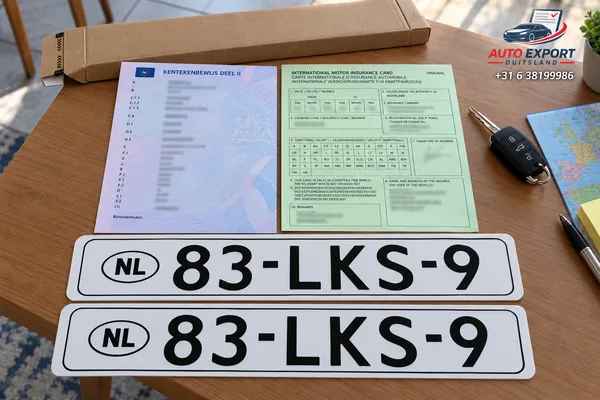
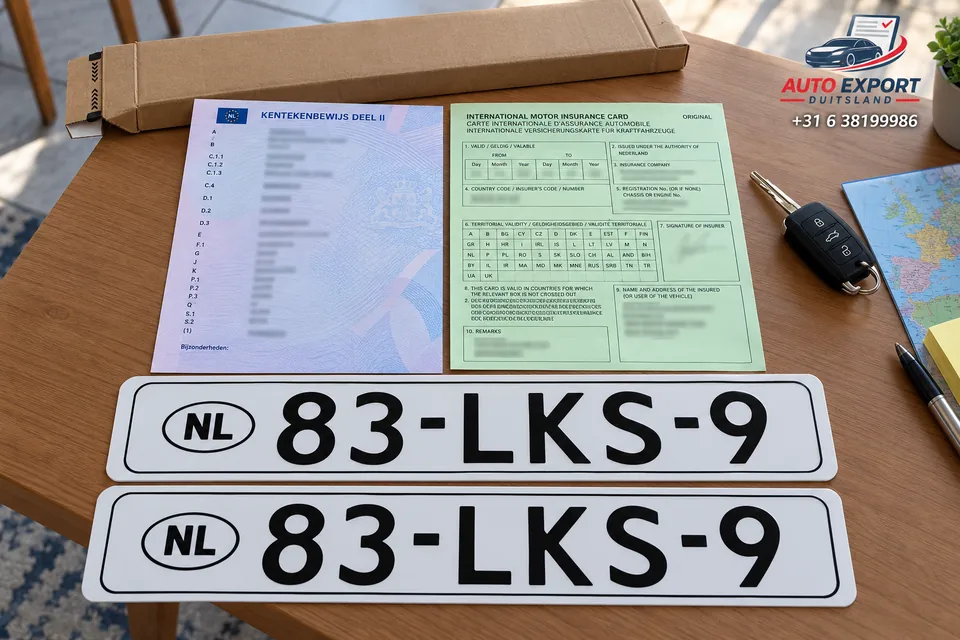
At our desk the van or truck gets its export document, and for the drive white export plates and export insurance. A truck, like a van, also needs a valid APK (Dutch roadworthiness test) to be driven on Dutch roads. The table below shows insurance, APK and the number of white plates per vehicle type. For a van or truck over 2,500 kg the price is on request; see our price list.
For a business buyer we need the company name, address and VAT number. The company name can only appear on the export certificate if you export at an RDW location, not at our desk; this also applies to German dealers. A used van can qualify for the BPM refund on export. No EX-A customs declaration is needed, as the vehicle stays within the EU. Selling a company van to a buyer abroad? See selling a car for export. For motorhomes, read importing a motorhome, caravan or trailer.
| Vehicle | Insurance required | APK (Dutch roadworthiness test) required | White plates |
|---|---|---|---|
| Car, van, truck or motorhome | Yes | Yes | 2 |
| Motorcycle, scooter or moped | Yes | No | 1 |
| Caravan or trailer over 750 kg | Yes, export insurance | Only above 3,500 kg | 1, with its own registration |
| Trailer up to 750 kg | Yes, on the chassis number | No | 1, with the towing vehicle's registration |
Sources: RDW (APK and export registration) and the Dutch government (registration plate of a trailer up to 750 kg). Export insurance for a caravan or trailer is part of our own export procedure. The export registration is valid for 14 days, but not beyond the APK expiry date.
Exporting today?
Call or message us for free advice or an appointment, also outside office hours. On Sundays a higher rate applies; you always know the price in advance.
Questions about vans, trucks and the Lkw-Maut in Germany
Does a heavy van from the Netherlands pay Lkw-Maut in Germany?
Only if its technically permitted maximum mass is over 3.5 t and it is intended or used for goods transport; the tradespeople's exemption covers vehicles under 7.5 t carrying goods for their own trade, as long as the transport is not commercial. The drive to the buyer can be subject to toll too, so ask BALM or Toll Collect in advance.
Can our company name go on the Dutch export certificate?
Only if the export is done at an RDW location, not at our desk. For a business buyer we still need the company name, address and VAT number for the insurance and plates.
Which Zulassungsstelle registers a company van?
The Zulassungsbehörde of the company's seat or of the branch concerned. Berlin asks for a Gewerbeanmeldung or a Handelsregister extract, as an original or certified copy, and the identity document of the person authorised to represent the company.
Can I claim BPM back on an exported van?
Possibly. The Dutch refund scheme covers used passenger cars, vans and motorcycles that meet the conditions of the Belastingdienst, including registration abroad within 13 weeks of export status. Our BPM refund service checks the conditions; the Belastingdienst decides.
What does exporting a truck over 2,500 kg cost?
The price is on request, because heavier vehicles can involve higher insurance and handling costs. We always confirm the price in advance.
Sources on commercial vehicles, tax and toll
- EUR-Lex: Verordnung (EU) 2018/858 (Genehmigung und Marktüberwachung von Kraftfahrzeugen und Kraftfahrzeuganhängern)
- Bundesministerium der Justiz (gesetze-im-internet.de): § 75 FZV, Einzelnorm (Zuständigkeit)
- Bundesministerium der Justiz (gesetze-im-internet.de): § 8 KraftStG 2002, Einzelnorm
- Bundesministerium der Justiz (gesetze-im-internet.de): Anlage VIII StVZO, Einzelnorm (Untersuchung der Fahrzeuge)
- Bundesamt für Logistik und Mobilität (BALM): Ausdehnung der Lkw-Maut auf Fahrzeuge mit mehr als 3,5 Tonnen technisch zulässiger Gesamtmasse (tzGm), 01.07.2024
- Bundesministerium der Justiz (gesetze-im-internet.de): § 6 FeV, Einzelnorm
Checked on 1 November 2026