
How to register a car in Germany after buying it in the Netherlands
A practical guide to car registration in Germany for a vehicle from the Netherlands: papers, HU, eVB and the appointment. We handle the Dutch export; the new owner applies for the German Zulassung.
- Dutch export document from €50
- Dutch papers checked for the Zulassung
- Free advice by phone and WhatsApp
from €50
Registering a car in Germany that was last registered in the Netherlands takes two separate steps. First the car leaves the Dutch register, which we arrange at our RDW-recognised desk in Hengelo. Then the new owner applies for the Zulassung (registration) at the German Zulassungsstelle. This guide follows the Fahrzeug-Zulassungsverordnung (FZV), the federal registration rules, and the published document lists of Berlin and Munich.
The rules are the same across the country, but each Zulassungsstelle runs its own appointments and may ask for extra papers. Use this page as a checklist, and ask your local office if anything is unclear.
Before the Zulassung: the Dutch export of the car
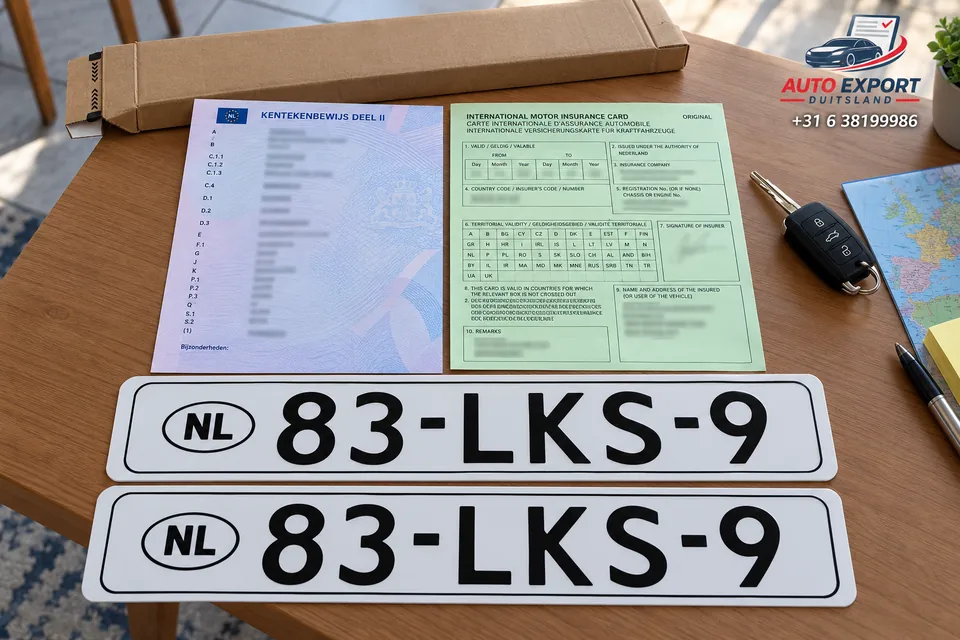
The RDW advises against deregistering a car for export before you know which documents the other country needs. For a German registration these are the export certificate, also called kentekenbewijs deel II, together with the kentekencard (registration card) with one corner cut off. You hand both to the Zulassungsstelle.
If you buy the car from a Dutch seller, you export it in your own name. Your details then appear on the export certificate, and the seller receives the vrijwaringsbewijs, the proof that their registration has ended. If you cannot travel to the Netherlands, a contact person there may arrange the export for you. The page on Dutch car export documents explains each paper.
Is the car already in Germany, for example after a move? Then we can still arrange the export with deel II, fully remotely by post: DHL standard takes about 5 working days, DHL Express about 1 working day. Please contact us first, so we can tell you what we need and what it costs.
The drive across the border on Dutch export plates
After deregistration the car may be driven on Dutch roads for 14 days, and never longer than its APK (the Dutch roadworthiness test) is valid. There are no transit countries on the way. German law temporarily admits a foreign vehicle with a valid foreign registration and third-party cover, and the ADAC names the Dutch export plate as the usual route for this drive. The rules for Dutch export plates vary by country, so ask the Zulassungsstelle before you drive on after the first 14 days.
Plan the HU and the appointment within those 14 days, or choose transport on a trailer. Read more about the white Dutch export plates and the export insurance with a Green Card.
Registering a car in Germany, from Meldebescheinigung to plates
The Zulassungsstelle asks for, among other things, the papers below. Berlin and Munich publish similar lists; Berlin's list for used vehicles from another EU country is a clear example.
1. Registered address and the right office
You apply at the Zulassungsbehörde, also called Zulassungsstelle, of your place of residence; if you have more than one, that of your main residence. Companies go to the office of their seat or of the branch concerned. Without a residence in Germany you need an Empfangsbevollmächtigter (authorised recipient) and apply where that person lives. Bring an identity document with a Meldebescheinigung, the proof that you are registered at a German address.
2. CoC, Datenbestätigung or Gutachten
With an EU type approval you show the CoC (EU certificate of conformity). With a national type approval you need a Datenbestätigung (the manufacturer's data confirmation), and with an individual approval the matching certificate. Without any type approval, a Gutachten nach § 21 StVZO (a full technical report) is required. We offer CoC assistance on request.
3. HU or an inspection report
Whether the car needs a new HU depends on its inspection history; the next section explains the rule.
4. eVB from a German insurer
An eVB (electronic insurance confirmation) proves the German Kfz-Haftpflichtversicherung, the compulsory third-party cover. You get it from the German insurer you choose; our Dutch export insurance cannot replace it.
5. SEPA mandate for the Kfz-Steuer
For the Zulassung you sign a SEPA direct debit mandate for the Kfz-Steuer, the annual vehicle tax. Berlin states that bank details are compulsory.
6. Appointment with all originals
Plan for an appointment at the counter of the Zulassungsstelle: online registration (i-Kfz) has not been confirmed for a car with Dutch papers only. Bring all papers in the original, including the purchase contract or invoice. A representative with a power of attorney may apply on your behalf.
TÜV Germany: when the car needs a new HU
The HU (Hauptuntersuchung) is the German periodic roadworthiness test, carried out by inspection bodies such as TÜV or DEKRA. For a car with EU type approval that was already in use in another EU country, § 8(2) FZV requires an HU before registration only if, under the German intervals, an inspection would have been due in the meantime and no inspection from the previous EU country is shown. A passenger car has its first HU after 36 months and then one every 24 months.
You must also show when the car was first put into use. If you cannot, an HU comes first. Munich only accepts inspection reports from EU countries for vehicles with an EC type approval, in the original. A valid APK report (the Dutch periodic test) can therefore make a new HU unnecessary, but ask your Zulassungsstelle in advance whether it accepts the report.
German number plates and the Zulassungsbescheinigung
At the appointment the car is registered: it receives a registration number, the number plates are stamped and you receive the Zulassungsbescheinigung, the German registration certificate. Part II is issued once you show, with the purchase contract or invoice, that you are entitled to the car. You have the German number plates made yourself, and the Zulassungsstelle stamps them. A Wunschkennzeichen (personalised number) costs an extra fee.
The Zulassungsstelle keeps the original Dutch papers. That is one more reason to have the export certificate in the right name before you go.
Fees for car registration in Germany
The federal basic fee for a Zulassung is €30 (GebOSt no. 221.1). The total at the counter varies by Zulassungsstelle and can be higher. After registration the Zoll (German customs) sends the Kfz-Steuer assessment, and a private buyer only pays German VAT on a new vehicle. On the Dutch side our prices start from €50 for the export document. All costs are listed on the page about the cost of registering a car in Germany.
| Service | Included | From |
|---|---|---|
| Export document | Export certificate, vrijwaringsbewijs (indemnification certificate) and RDW processing | €50 |
| Export insurance + white plates | 14 days liability cover, Green Card and white export plates | €100 |
| Complete export package | Export document, vrijwaringsbewijs, 14 days liability cover, Green Card and plates | €150 |
| Export insurance extension | 14 extra days of liability cover with a Green Card, requested online (per 14 days) | €120 |
When can the price be higher?
- All amounts are starting prices, including VAT where applicable.
- A surcharge may apply outside office hours. Office hours: Monday to Saturday 10:00 to 16:30. On Sundays you are welcome by appointment, at a higher rate; call or WhatsApp first for the final price.
- Postal delivery costs more; the same postal rate applies to the Netherlands and abroad.
- The price can differ per vehicle, for example for heavy or non-standard vehicles.
- You always know the price in advance.
All rates, including postal delivery, caravans, trailers and custom work, are on the page Prices and costs for Germany.
Timing: when to register and how long it takes
If you move house, the car must be registered straight after the move: see moving to Germany with a car. There is no official average processing time. With complete papers the registration itself is usually one appointment; as an indication, allow a few days to a few weeks, depending on waiting times in your city. If you want a BPM refund on export, the German registration must be completed within 13 weeks of the RDW giving the car export status.
Common mistakes when registering a Dutch car
- No CoC: without type approval papers you need a Gutachten, which can take longer.
- Missing deel II: if part II of the Dutch certificate is missing, the car can only be registered after a confirmation from the Dutch authority via the Kraftfahrt-Bundesamt (KBA).
- Expired inspection: if the APK has run out, expect a new HU before registration.
- Appointment booked too late: the 14 days on export plates run out while you wait.
- Deregistering the car yourself: according to the RDW, you then receive no export certificate.
Exporting today?
Call or message us for free advice or an appointment, also outside office hours. On Sundays a higher rate applies; you always know the price in advance.
Questions on registering a Dutch car in Germany
Which office handles car registration in Germany?
The Zulassungsbehörde, usually called Zulassungsstelle, of your place of residence; with several residences, that of your main residence. Companies apply at the office of their seat or branch. Without a residence in Germany you apply where your Empfangsbevollmächtigter (authorised recipient) lives.
Does a car from the Netherlands need a new TÜV inspection?
Not always. Under § 8(2) FZV an HU before registration is only required if a German inspection would have been due in the meantime and no inspection from the previous EU country is shown. A valid APK report can make a new HU unnecessary, but ask your Zulassungsstelle in advance.
Can I register the imported car online?
Online registration (i-Kfz) is described for German documents. For a car with only Dutch papers it has not been confirmed, so plan for an appointment at the counter of the Zulassungsstelle with all original papers.
What if the car has no CoC?
Then the Zulassungsstelle needs a Datenbestätigung for a national type approval, or the certificate of an individual approval. Without any type approval a Gutachten nach § 21 StVZO is required. We offer CoC assistance on request; the route varies by manufacturer and importer.
Does the Zulassungsstelle keep my Dutch registration papers?
Yes. The office takes in the original Dutch papers when it registers the car. That is why it matters that the buyer exports the car in their own name, as the RDW advises, so that their details appear on the export certificate.
Can someone else register the car for me?
Yes, a representative with a power of attorney may apply. Berlin accepts an informal power of attorney with the identity documents of both people; Munich asks for a written original, the representative's own identity document and a copy of yours.
How long does registering a car in Germany take?
There is no official average. With complete papers the registration is usually one appointment; as an indication, allow a few days to a few weeks, depending on waiting times. A missing CoC or deel II can make it take longer.
Sources for the registration rules and fees
- RDW: Voertuig naar buitenland: kenteken stopzetten
- Land Berlin (service.berlin.de), Kfz-Zulassungsbehörde: Zulassung eines aus dem EU-Ausland / EWR eingeführten Gebrauchtfahrzeuges
- Landeshauptstadt München, Kfz-Zulassungsstelle: Aus dem Ausland eingeführtes Fahrzeug anmelden
- Bundesministerium der Justiz (gesetze-im-internet.de): § 8 FZV, Einzelnorm (Zulassung nach vorheriger Zulassung in einem anderen Staat)
- Bundesministerium der Justiz (gesetze-im-internet.de): § 75 FZV, Einzelnorm (Zuständigkeit)
- Bundesministerium der Justiz (gesetze-im-internet.de): Anlage GebOSt, Einzelnorm (Gebührentarif)
Checked on 1 November 2026